
Building Versus Bringing Relationships

“Can you get us in front of (insert well known philanthropist)?”

“Who do you know?”

“Will (local philanthropist) make a big gift to support us?”

Sometimes these questions are explicit and sometimes they are implicit when boards are considering a consultant. Of course they are all well intentioned, every board wants their efforts to be successful. But they raise an important distinction when working with a consultant—bringing a list of contacts versus building lasting relationships.

Fundraising is built on relationships and many boards look to their consultant to bring in new donors, particularly those with high gift capacities, to make their campaigns successful. While well-meaning, these hopes are often misplaced for a few important reasons:

1.      Perhaps the donor you are coveting simply does not have an interest in your work. It can be a hard pill to swallow—we all steadfastly believe in the missions of our organizations. Still, many boards believe, “If we could just get in front of Mr. and Mrs. Smith, I’m sure we could convince them to make a gift.” While we like to think we can convince and persuade donors, sometimes their passion and motivation is just with another cause.


2.      If a consultant comes to the table promising meetings with local philanthropists, a board should inquire about relationships that are made during their engagement. Will their donors be the ones offered up at the next pitch? How will data and giving information be protected?


3.      Perhaps most importantly, relying on a consultant’s relationships takes a short-sighted approach. When the consultant leaves, so does the relationship.


A more strategic approach positions an organization for long-term success by building relationships with multiple people already in the organization—boards, development staff, and leadership. This does not mean a consultant should come empty handed. They should have resources and methods for discerning who is close to an organization and may be able to make an introduction to a new donor. They should know the donor landscape and interest of major potential donors. And they should be able to develop strategies for engaging new donors and building relationships.

By developing multiple points of contact throughout the organization, nonprofits ensure that a relationship will endure beyond a consultant’s contract (or a development/executive director, for that matter).

Building relationships also underlies an important truth—a campaign’s success will be largely based on the donors and relationships an organization already has. Taking someone from zero interest to a lead gift is difficult, and the success rate is low. If you can engage a brand new high-capacity donor in your campaign, its far more likely their lead gift will actually come in your next campaign.

And that is totally fine! Building relationships and deepening a donor’s relationship with an organization can take time. So the next time you are offered a short-term, surefire solution, be cautious and ask the right questions.

Three (or 4) Cheers for the Volunteers

“Our volunteers were so prepared for the demands of this campaign; I think they are ready for the next one!” – Overheard by no one, anywhere, ever.

But how nice would it be if your volunteers walked into the next campaign or event planning meeting energized and encouraged? Thankfully, the best thing you can do to prepare your volunteers in advance for a campaign is also the same thing you would do to increase the overall health of your organization: consistent motivation and encouragement.

Here are a few ideas to get that started:

 1.     Be intentional about letting volunteers know when they have done a good job or had an impact. BF Skinner’s Reinforcement Theory reminds us that consequences influence behavior. And just like children, adults who are given positive attention or recognition are more likely to remain or increase their positive behavior and actions with your organization.

2.     Share positive gossip such as, “I heard that you did a great job the other day on…” Secondhand compliments are more valuable than when you praise the volunteer yourself.

3.     Give regular feedback. It is easy to assume volunteers know that they are appreciated or are doing a good job. But without regular check-ins, many people tend to fall into a spiral of doubt. Thoughts such as, “I am probably not even needed, why would I show up again?” Or, “I doubt they remember all the work I did last year anyway,” are all too common. Volunteers need to know that their work was seen, valued, and appreciated. And they probably need to be told more than once.  

4.     Thank the families of volunteers. Families all look different, but when those who are closest to the volunteer know that they are impacting the organization and making a positive difference in the world, the volunteer feels even better about their contributions. Do this by inviting someone close to the volunteer to an event and personally thanking them for giving up time with the volunteer so they can help your organization.

No campaign is successful without a core group of dedicated volunteers. A campaign often demands late-night or early-morning meetings to tackle what may feel like a lofty goal. But an organization whose volunteer morale is consistently maintained from before a campaign even begins will have unparalleled energy, driving the campaign to its goal and organically building the next tier of dedicated volunteers.


Sources: https://www.managementstudyguide.com/reinforcement-theory-motivation.htm


Coronavirus and Philanthropy

The last week has brought perhaps the swiftest and most dramatic changes to life around the world any of us have ever witnessed. While a natural disaster or terrorist attack may only directly affect a city or even an entire country, the coronavirus is having an impact on the entire globe, nearly simultaneously.

From a philanthropic standpoint, the coronavirus presents a multi-faceted challenge. While many fundraisers have lived through financial downturns and crises, never before has any type of in-person social interaction been so restricted, resulting in the cancellation of events, and even most in-person meetings.

Let’s be clear—we are all in uncharted territory. If anybody tells you that they know exactly how this will unfold, run the other way. Just think, a week ago we thought there was a possibility March Madness would be played, simply without fans. In less than a week, we are now told to avoid gatherings of more than 10 people.

While we don’t know exactly what the following weeks and months hold, we offer the following advice for fundraisers in these challenging times.

Take time to build relationships. Pick up the phone and call your donors—we know chances are good they are at home, and some may even be craving social interaction. Ask how they are feeling, and do not be afraid to talk about any challenges facing your organization. It may not be the right time to make a major, multi-year gift request, but you may be surprised which donors raise their hands and step up to meet the immediate needs of your organization. Too often we think just about “the ask.” Now is the time to focus on the important work of building relationships that comes before (or after) a request.

Communicate your (immediate) needs. Many organizations will face increased demand for their services over the coming weeks and months and we have seen time and time again that donors will step up to meet those demands. Don’t be afraid to communicate those challenges and ask people to support your organization in this time of need, especially if you are setting up programs specifically designed to aid people affected by the crisis. But the dynamics are changing for all organizations. Get creative to think of ways you can continue to fulfill your mission. How can you use technology to continue your mission when donors and beneficiaries cannot be at your physical location? If your employees must be physically present to carry out that mission, how can donors support them?

Stay positive and take care of yourself. It is easy to get lost in the nonstop breaking news alerts, cancellations, and closures. It seems like a year’s worth of bad news has been stuffed into the last week. Added to that, all our normal escapes like sporting events, festivals, and concerts are canceled. If you have never tried meditation, it might be the week to start. Many apps like Headspace are offering free services during the crisis and normally offer nonprofit discounts. Having conversations with your donors will also help. Sharing a laugh or lighthearted moment can go a long way.

If you have specific questions or tactics you would like to address, the EDEN+ team is offering free 30-minute consultations as we work to support our nonprofit partners in these challenging times. To set-up a time to speak via video chat or phone, please contact info@edenplus.org. Stay safe, and wash those hands!

A "Noble" Prize

I recently heard a song that used to come on the radio at least once daily in the 90’s in my mom’s minivan. You know those songs that 8 year-old-you knew all of the words to? But a few years later, “adult-you” realizes your version of the chorus was way off? I do that a bit more than I’d like to admit.

One of my more memorable childhood discoveries was that the Nobel Prize wasn’t just for “nobles.” Turns out it was named after the dude who invented dynamite. And although this is common knowledge, there is a part of the story that gets left out quite a bit. It is a detail in Alfred Nobel’s will, which outlined his plans to leave the majority of his fortune (from his 355+ patents on mostly explosives) to random strangers doing good work worth recognizing.

No one is quite sure why Alfred put these plans into his will (there are a few theories if you have time to take a deep dive into history), but it is safe to say his family was a little unpleased and a lot surprised at the news of their lost inheritance. Whatever his reasons were for establishing the prize (and keeping it a secret while he was alive), Mr. Alfred Nobel’s prize had a clear purpose: recognizing the individuals contributing the best work to better this world in the fields of physics, chemistry, physiology or medicine, literature, and peace.

So what does any of this have to do with the work we do at EDEN+?

Although I had some confusion about whether or not this prize was just for “nobles,” I knew the name Nobel. And you would be hard-pressed to meet someone today who wouldn’t recognize the name and immediately associate it with the awards given out. 

In our work at EDEN+, we are privileged to work with many individuals who have a legacy of their own to leave. But setting up all the parameters for such a legacy gift is not simple. One part of campaign management often includes guiding nonprofit leadership to create opportunities for legacy gifts. Naming a prize, as Alfred did, or naming a new building are just a few of the ways nonprofits can empower their donors. Gifts that allow donor recognition come in the form of scholarships, named rooms, programs, outdoor spaces, entire buildings, and the list goes on.

Who are the buildings, awards, and community spaces in your city named after? Do you know their stories? Next time you find yourself sitting in a gymnasium or theatre or hospital waiting room, look around and see if someone’s last name is on it. You may begin to notice the many names of inspiring individuals who have taken what they believe in and generously given to ensure that good work continues, even after they are gone.

Building Healthy Expectations with Fundraising Data (Part Two)

In part one we discussed how data is imperfect--the expectation should be that it makes you more accurate than simply guessing. But when it comes to major gifts, data won’t replace a skilled fundraiser’s ability to build a relationship with a donor. And in building a relationship with a donor, you can add unstructured data (about a donor’s passions, for example) and refine and validate structured data about family, careers, and wealth.

This use of personal, more anecdotal data to supplement anything captured in a spreadsheet is a powerful combination when used at both for-profits and nonprofits. Steve Lacy, Executive Chairman of Meredith Corp. whose publications include Time magazine and Better Homes & Gardens, tells a story about the use of data in their marketing department. A Senior Vice President came into a meeting excited by the treasure trove of data they were able to compile about their readers claiming, "We know our customers better than they know themselves!" He reflected by saying, "I almost fired her on the spot!" He admitted that while they are able to utilize significant data including buying and personal habits, the data tells an incomplete story. "Each customer has their own story." Just as each potential donor has theirs. 

Information from data services should serve as a starting point to provide some background and general expectations. It can help inform who you should be visiting and add detail where a donor may not offer it. For example, a donor may disclose that they recently sold their business, but without research you may not know how much it sold for. For these reasons (and even just to avoid looking a little creepy) fundraisers should still enter early prospect conversations with a curious mind. Asking open ended questions, about children or a career as examples, can validate or discredit research done beforehand.

Appending data points about donors is a useful exercise, but simply adding a column to a spreadsheet doesn’t ensure fundraising success. Data is a supplemental tool that can help prioritize and identify donors, analyze fundraising programs, and inform ask amounts. But data doesn’t build relationships. That requires skilled fundraisers who can sit across from a donor, uncover what their passions are and communicate how your organization speaks to those passions.


Building Healthy Expectations with Fundraising Data (Part One)

Like most industries, the collection and use of data has been a hot topic in fundraising over the past decade. Fundraising has benefited greatly from data, and many in the field continue to pioneer new uses and applications that benefit both fundraisers as well as the donors they interact with.

But with all the data hype, many fundraisers and boards unfairly expect data to be perfect—a cure to all challenges. Although much of today’s data is very accurate and getting better, it will never meet that standard. Too often, one experience with inaccurate data damages trust of the information and supersedes all the instances where additional data was helpful.  For example, an organization pulled a profile from one of the big data services for a well-known donor in Des Moines which mistakenly listed the donor’s daughter's name under "Spouse". Luckily this faux pas didn’t damage the relationship with the donor, serving only as a reminder of the importance of validation (more on validation in part two).

Assuming data is perfect will inevitably lead to disappointment. The point of data is that it provides information that makes a prediction more accurate than simply guessing. For example, if I asked you how many points you think Los Angeles Lakers guard Kyle Kouzma will score in his next game, you would likely be pulling a guess from thin air (unless of course you’re a Lakers fan). But if I provided the additional data that he’s averaging 18.8 points per game this season, your guess would be a lot more accurate. Adding data points about Kouzma’s average in home versus road games, as well as the defensive ability of the team he’s playing would help refine your guess even further.

In a fundraising context, think of the benefit of more accurate information to inform ask amounts. Suppose you visit a donor who is passionate about your cause but lives in a very modest home. Because of their passion and gift history, you plan to ask for a $10,000 gift. But like the Kouzma example, adding an additional data point indicating the donor has a high net worth would likely revise your ask amount upwards. Now let’s say, based on this additional net worth information, you decide to ask this donor for $50,000. If they decline that amount but say they will donate $30,000, it might seem like a disappointment based on the ask amount. But even though the ask amount wasn’t perfect, the additional information still resulted in receiving three times the amount you would have without the data.

In part two, we will explore the importance of data and validation and building personal relationships with donors.

Hidden Millionaires

When we think of wealth, images of private jets, mansions, and luxury cars often pop into our heads. But a new report from WealthEngine suggests that most millionaires aren’t signaling their wealth with these stereotypical symbols, presenting a significant opportunity for nonprofits and fundraisers.

According to WealthEngine, approximately 12.7% of the US population is made up of millionaires. That’s 19 million millionaire households and 30 million individuals. While that number might be more than you expect, it’s also important to consider 95% of millionaires have a net worth between $1 and $5 million (and the majority of those are under $2.5 million). There’s a lot of millionaires out there, but still a relatively small number that fall into the ultra-wealthy category that often comes to mind.

And many of these millionaires often don’t display the outward signs we commonly associate with wealth. For example, the most popular car brands among millionaires are Toyota, Ford, and Honda (Mercedes is tops with the $25 million+ crowd), and only about 15% own property valued at over $1 million.

The moral here is that as fundraisers, it’s important we don’t prejudge the wealth of our prospects based on what we see. Just because they weren’t a Fortune 500 CEO or live in a $10 million mansion doesn’t preclude them from making major gifts that have significant impacts on our organizations.

The report also underscores the value a wealth screen can provide. It’s easy to think that maybe someone isn’t capable of making a “major gift” because they arrive to your meeting in a Honda instead of a Mercedes. A quality screening not only uncovers wealth that may otherwise be hidden below the surface, but also removes the subjectivity and biases we all have as humans.

Source: WealthEngine 2019 U.S. Millionaire Report

Waiting to Ask Can Be Costly

When it comes to fundraising, one of the most vexing variables to deal with is often timing. When do we ask for the gift? Organizations that provide services to potential donors fear that asking too soon after an interaction may come off as opportunistic and turn donors off. However, a new study from Katherine Milkman, Judd Kessler, and Amanda Chuan at the Wharton School shows that sooner is far better than later when it comes to asking for a gift after providing a service.

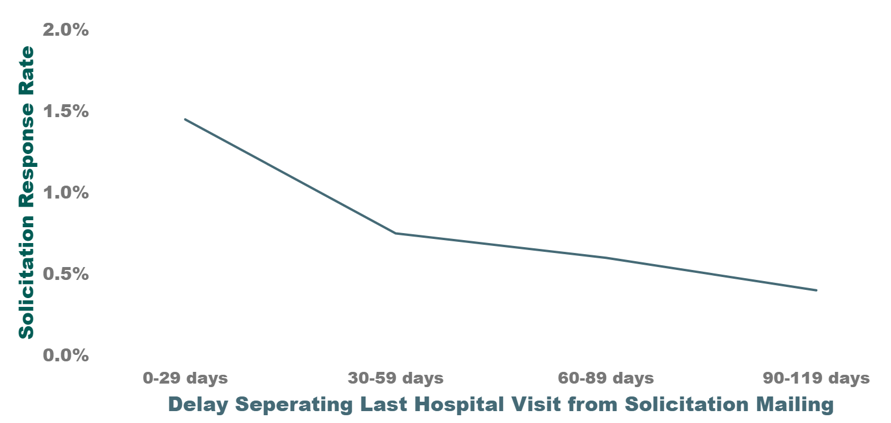
The study examined a major hospital system and analyzed response rates to direct mail solicitations and how they related to time passed since a hospital visit. The researchers discovered that as more time passed between visit and solicitation, donors were less likely to make a gift. In fact, waiting an additional 30-days to send a solicitation after a visit decreased the likelihood of a donation by 30%.

blog graphic.PNG

These findings have implications beyond hospitals and can be applied to any organization that provides a service to their potential donors, including education, religious, and arts organizations. A community theater, for example, could increase giving by sending solicitations to ticket buyers within 30-days of seeing a show, instead of waiting for a quarterly or annual appeal.

Intuitively, the study suggests that a potential donor receives a positive feeling that engenders reciprocity after receiving a service from a nonprofit, but that feeling fades over time. The sooner you can make an ask after that seed of reciprocity is planted, the more likely you are to receive a gift.

The Hidden Benefits of a Feasibility Study

I was the President of the Board and after my term was up I did not heard a single word from the organization for years until you called. I love [the organization] but I feel like they forgot about me.
— Feasibility Study Interviewee

The goals of a feasibility study are fairly straightforward. Organizations often want to know first if they can conduct a capital campaign, if so how much they can raise, and then how long it will take them to raise the money. 

These are obviously important questions to answer but there are several more benefits of a feasibility study that can be overlooked as strategically beneficial. Let us explore a few of them below. 

Database Cleaning and Housekeeping

During a feasibility study an organization will want to compile a list of stakeholders, donors, and other entities. What you may find is that in the process of inviting individuals to participate in a feasibility study interview you may discover that the contact information you have for some of your closest supporters is no longer correct. Returned mail, landlines disconnected, and professional information no longer valid are common occurrence. 

In the quote at the beginning of this article the person had changed jobs, moved, and transitioned off the board all within a matter of months. They were suddenly completely lost to the organization. The feasibility study gave the organization an opportunity to reconnect with the individual, listen to their concerns, apologize and fix the situation, and ultimately bring a beloved supporter back into the fold. 

The concern over even a single example inspired the organization to run the entire 5,000 constituent database through a National Change of Address clearing house. The result was a recapturing of 8% of their previous donors. 

Stewardship

Donors and stakeholders want to help and welcome opportunities with little time or financial investment to make a difference. Frequently an e-survey is implemented as part of a feasibility study. A survey is a great way to focus on those who do not always receive the white glove experience. Your grassroots supporters and volunteers are sometimes the front line and their advice can be incredibly important but by closing the loop and making sure that they know their voice was heard they will feel even more entrenched in your mission. 

Volunteer Recruitment

If your organization relies on volunteers on a regular basis being involved in a feasibility study may prompt an individual to think about how they can get more involved. Involvement might include single events stuffing envelopes, mission-driven recurring volunteering, or even serving on your board. No matter how your stakeholders want to get involved a feasibility study can help you recruit volunteers and have your volunteers understand how important their contribution can be. 

Staff 

Every organization can benefit from developing a culture of philanthropy. Each employee of the organization can think about how they impact fundraising whether it is via storytelling, information gathering, or helping directly with donor cultivation. When the entire organization focuses on fundraising it is not simply a linear result because each person benefits from the inputs of another and the best ideas rise to the top with full buy-in. 

Focus on the Goal

Each of these secondary benefits has a direct impact on the original goal of the organization which is to elevate the mission through funding and capital resources. When all of these stepping stones are developed the final result is an even greater potential. 

First Time Warning Signs

So you are thinking about hiring a fundraising consultant but you are worried because you have heard horror stories? Here are a few red flags to look out for as you talk to firms and independent consultants. 

"I can guarantee that you will raise $10 million."

If any consultant guarantees this they should play the lottery! No one can know the full financial situation of every donor nor can they know how an organization might change during a fundraising effort. When this false hope is offered it is intended to get started and then extend contracts unnecessarily when you do not meet your goal. One way to resolve this issue is to have a clearer picture of what the potential is for a campaign by conducting a feasibility study. The study does not always correlate to the results of a campaign, but will absolutely inform your decision to go forward.  

"I used to work for a big organization in town and can bring those donors to you."

While there is definitely something to be said for understanding the philanthropic landscape of a region, a consultant who is willing to take a donor from another organization they worked with will be willing to take your donors when they leave. If you hear this line you may want to ask them if they are a member of the Association of Fundraising Professionals (AFP) and if they have read the Code of Ethical Standards recently. 

"I know your budget is small and you are worried about how much we can raise so I will just charge you a flat percent of contributions."

This is a double threat! The first threat is that they could potentially then convey fraudulent information to your donors or bully them in order to falsely increase the amount pledged. Point them back to the Code of Ethical Standards again. This will chase your donors away faster than anything and do long term damage to the reputation of your organization. But let's give them the benefit of the doubt and say they act responsibly. The second threat is that by taking a percentage they then become a stakeholder in your organization and by definition non-profits may not have financial stakeholders and that could threaten your tax-exempt status. Can you even imagine the implications of that?

So whether you are deciding that a consultant is right for you because you need the expertise or the manpower, make sure you find someone who is knowledgable and that you are securing your own interests. And if you have any questions about something a consultant has said to you feel free to ask Eden+ about it to give you a little peace of mind.